Hohsalle
The Deer KingHohsalle is a gifted physician whose work makes the medical legacy of the fallen Ancient Kingdom of Otawalle both a source of healing and a challenge to Zolian religious authority. At twenty-six, he directs the research wing of the Institute of Medicine and is already known throughout the Zolian Empire; his investigations into black wolf fever show how his commitment to treating disease brings him into contact with patients, political authorities, and a rival medical philosophy.
Identity and Background
A descendant of the great ruler who founded Otawalle, Hohsalle belongs to the Sacred and carries a lineage that distinguishes him in Zolian society. He trained under his grandfather, the renowned physician Limuelle, and his talent emerged early: he began teaching at the Otawalle Academy of Deeper Learning at fifteen. By twenty-six he had become director of the academy’s research wing, while his assistance in curing Emperor Natalu’s wife had brought him fame across the empire. That public standing rests on a practical record as well as inherited status: before the imperial cure made his name, he had already saved people from mortal injury and disease.
His authority is complicated by the suspicion attached to Otawalle medicine. Zolians regard physicians as “the fingers of the god,” and under the Pure Heart Creed, priest-doctors are expected to follow divine teachings in deciding how to care for the sick. Hohsalle and Limuelle’s success in treating the emperor’s wife challenged that order. Natalu had summoned them despite objections from advisers who considered their remedies heretical; after they cured his wife, he asked them to stay at court and teach the priest-doctors. Their decision to decline the appointment calmed the immediate confrontation, but their success had already encouraged nobles diagnosed as incurable to seek Otawalle physicians privately. A decade later, Otawalle medicine remained officially branded as heresy, even as its results were difficult to ignore.
Investigating Black Wolf Fever
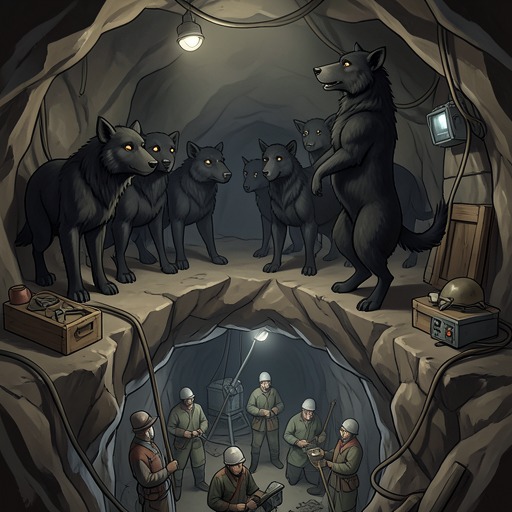
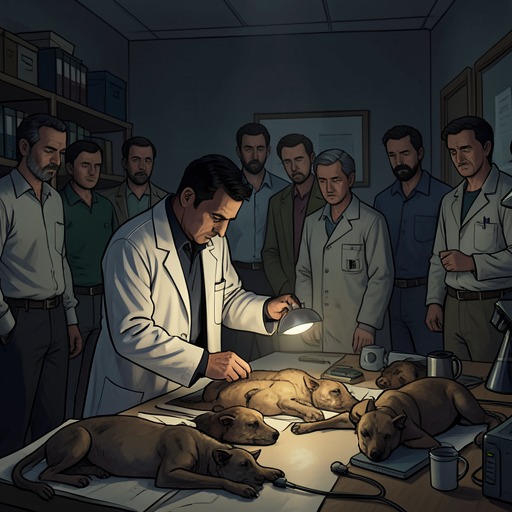
At the salt mine, Hohsalle studies the bodies of workers who have died in a disaster that the guards failed to prevent. His examination shifts attention away from an assumed food-related cause: he points out that the bodies bear dog bites and traces of a rash across them, and he refuses to name a disease before he can examine them more fully. When pressed by Yotalu, he offers a cautious diagnosis: the deaths may have been caused by Mittsual, or black wolf fever. He also distinguishes a risk that the frightened observers cannot see. Wolves and wild mountain dogs called ossam can carry the disease, but infected fleas and ticks make transmission more dangerous; cold weather leaves fleas largely dormant, though they can persist through winter in warm places, including a dog’s body or near a hearth.
For Hohsalle, the dead are not only evidence of loss but a possible source of knowledge. He explains to Makokan and Milalle that the bodies might yield three kinds of medical resource: disease agents that could be weakened for a preventive treatment, agents against which researchers might find a drug, and antibodies produced by victims that could help form a serum. His account links observation to a research program, while Makokan’s question—whether the dead victims’ antibodies could have failed—forces Milalle to clarify the distinction between having a possible immune response and having survived. Hohsalle’s investigations thus proceed through uncertainty rather than a claim that any one remedy is already proven.
The diagnosis also demands action beyond the research room. Yotalu reports that Governor Ohan and his eldest son, Utalu, have taken the threat seriously and asked him to consult Hohsalle. Hohsalle had held back from informing the Sacred Territory until he had the governor’s permission, aware that news of the disease could provoke panic and leave the realm vulnerable to invasion. Yotalu welcomes Otawalle support and says that Lona agrees; the governor, meanwhile, intends to manage the necessary approach to the court priest-doctors diplomatically while asking Hohsalle to share the Academy’s knowledge. Their response makes the outbreak a problem of public communication and political trust as well as medicine.
Treatment and Medical Reasoning
Hohsalle’s research treats prevention as an intervention in the body’s response to disease. He explains that the body contains different kinds of defenders, like the lookouts, archers, and engineers of a regiment. These defenders must learn to recognize a particular disease and be equipped to fight it. A weakened agent can teach that recognition by introducing a form too impaired to fight effectively; the principle builds on a discovery by Limuelle, who identified why some illnesses are experienced only once and devised a way to introduce weakened agents into the body.
That explanation becomes a difficult clinical choice when treatment must be offered to patients whose condition can worsen rapidly. Hohsalle says the preventive agent must be injected several times, with days between injections. He acknowledges both the risks and the limits of the evidence: in his method, twelve people have survived without symptoms, but there are still too few cases to establish that it is risk-free. He contrasts this prospect with rabies, for which the appearance of symptoms means certain death, and answers Utalu’s suspicion by noting that the dogs that bit the survivors died of rabies. In another urgent decision, he agrees with Milalle that patients may need treatment before a rash develops, but limits use of the serum to Zolian patients while allowing the weakened agent and anti-Mittsual drug for everyone. His choices register the outbreak’s uneven risks without disguising the uncertainty of the available treatments.
Relationships and Institutional Conflict
Hohsalle’s relationship with Makokan begins in an act of rescue. After Makokan, a stake-fighter, had been left for dead at the stadium, Hohsalle saved him from a wound that should have killed him. Makokan later serves as Hohsalle’s attendant and worries over him on the cold, rainy mountain journey, but Hohsalle’s brisk assurance that he is fine preserves their familiar difference in temperament. Makokan also becomes an important participant in Hohsalle’s work: his questions about the bodies and antibodies draw out explanations that might otherwise remain abstract.
Others read Hohsalle’s singularity less generously. Zolians call him the Devil’s Spawn behind his back, and a rumor attributes his power to save the dying to a bargain with the Lord of Hell. Makokan suspects that priest-doctors hostile to Hohsalle and Limuelle have helped spread the tale. Its supernatural language gives form to a medical and institutional unease: Hohsalle intervenes where the accepted practice would leave an incurable patient to divine care and provide only what eases the passage to death. The rumor makes his ability appear uncanny precisely because his practice contests who may decide that treatment has reached its limit.
His encounter with Sae shows a different mode of relationship. At Tohlim’s recommendation, Hohsalle approaches her directly, introduces himself as Hohsalle Yuguraul, and asks for her help. He is impressed by her directness and by Tohlim’s confidence in her. During the royal falcon hunt, by contrast, he handles formal rank with controlled composure: invited to a light meal by the king’s steward, he accepts the protocol even though he privately finds it bothersome, having earlier chosen another vantage point rather than spend the whole event with the king and his guests. These moments show how readily he can move between practical requests, intimate familiarity, and political ceremony without treating them as the same kind of exchange.
Medicine, Faith, and the Limits of Agreement
The outbreak brings Hohsalle into sharper intellectual conflict with the Pure Heart Creed. A priest-doctor describes the purpose of their practice as saving the human soul rather than extending life in a defiled body. Hohsalle recognizes that the disagreement cannot be resolved as an ordinary dispute over political influence: the two traditions begin from incompatible premises. The priest-doctors do not consider it necessary to search for the cause of disease, and Hohsalle realizes they will not consent to inoculating patients to prevent illness. Where he sees investigation and prevention as obligations, they see acceptance of mortality as part of their medical and spiritual duty.
Yet the encounter does not make cooperation impossible. Mana, a priest-doctor who has helped with treatment, declines Hohsalle’s offer to see the disease-causing organisms. He argues that examining patients is enough: disease can be understood as a form of defilement by its effects on the body, without identifying each organism. He wants to devote himself to observing the sick and helping them live good lives. Hohsalle listens, while Limuelle laments Mana’s decision but recognizes the value of inviting him to take part in care.
Limuelle then articulates the stakes of that invitation. He acknowledges the attraction of a doctrine that offers a settled answer, but insists that advancing knowledge requires examining the world’s disorder rather than accepting a final explanation in advance. In his view, priest-doctors’ resignation to disease helps patients and families accept fate but also makes them accept their own impotence. Otawalle physicians, by contrast, will not give up or ask patients to give up; a contagious disease affects more than the person who falls ill, because despair and untreated illness can allow it to spread. Limuelle urges Hohsalle to seek further opportunities to work with Mana. Winning priest-doctors to their side could loosen the institutional restraints on Otawalle medicine, opening access to funds and people and allowing its knowledge to reach Zolians of every rank.
Narrative Role
Hohsalle joins bedside care to investigation and political negotiation. The bodies at the salt mine first make illness visible through signs that demand careful interpretation; his account of transmission then turns those signs into a question of containment; his proposed remedies make that question one of experimentation, patient risk, and institutional consent. His work is therefore more than a contest between rival authorities. It tests what each medical tradition considers evidence, what it believes a physician owes a patient, and whether a society can learn from a practice it officially calls heretical. The contrast between a possibly preventable disease and a doctrine of accepting incurability gives Hohsalle’s research its central urgency.